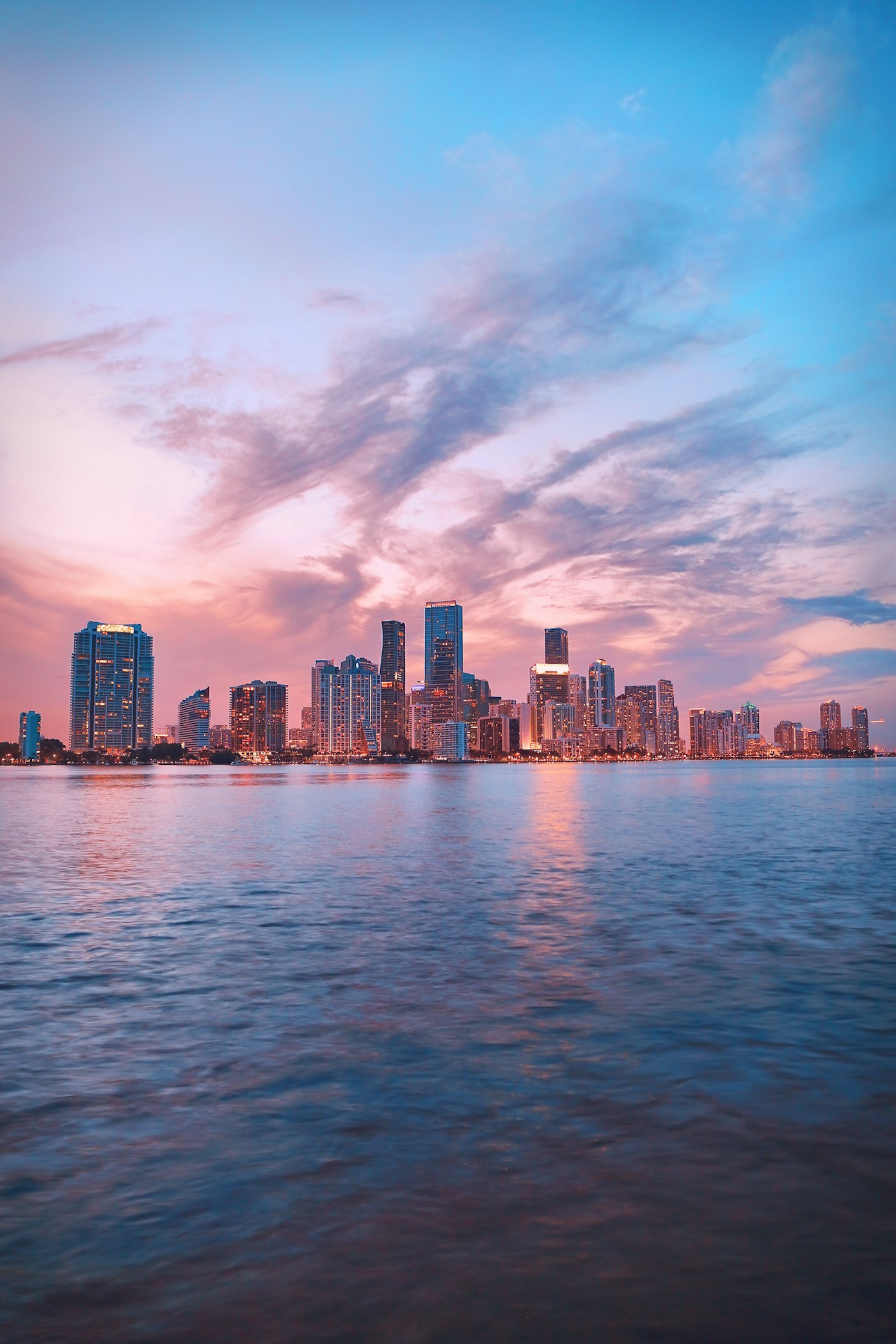
Miami, a 2026 city reportUSA · population 6.18 million metro (Miami metropolitan area, Miami Dade plus Broward plus Palm Beach) · index 7.7 of 10
An independent report on living in Miami, scored across cost, safety, weather, jobs, healthcare, education, transport, and twelve more axes. No tourism board input. No paid placement.
7.7
Index Score
Miami, USACover · The City Report
№ 01 — The Quick Take
Miami in 200 words.
Miami scored 7.7 on the everycity index in 2026. The headline numbers: rent on a one bedroom in the central districts runs 2,750 dollars/mo (2,750 USD), the monthly all in cost lands at 3,650 dollars for a single resident, the income tax position runs to a top combined rate of 37.0 percent federal, and the safety score is 7.0 on the same 10 point scale we apply to Tokyo, London, and New York.
Miami runs roughly 24 percent above Austin, 9 percent above Atlanta, and 18 percent below New York on the May 2026 basis. The full numbers run by category through this report. If you want the comparison view first, start with Miami vs Austin or Miami vs New York, then return here for the deep read.
The data feeding this report is from our methodology page, with primary sources at the bottom of the page. Numbers are May 2026 unless stated otherwise. Currency is the US dollar, with all figures USD.
One reading note. This is the long form report. If you only want the headline numbers, the city score generator returns the index figure with custom weights in 30 seconds. If you want the comparison view across two cities, the Miami vs Austin page is the first stop. If you want the full continent context, North America places Miami on the regional table. The cross references inside this page run thick deliberately. Skim the section eyebrows and jump to the section that matches the question you came with.
For new readers: this report sits inside Volume 04 of the everycity atlas, our 2026 issue. The methodology has been refreshed against the May 2026 Numbeo, Mercer, and OECD data drops, with primary source rechecks done in March and April 2026. Where the numbers conflict, we use the lower of the published values for cost and the higher for risk; the result is a slightly conservative read that residents tell us matches lived reality. The next refresh ships August 2026.
№ 02 — Cost of Living
The monthly arithmetic.
Twelve line items priced in May 2026 for a single resident living in a central one bedroom. Family of four numbers run roughly 2.5 times the single resident figure.
Line item
Single, 1 bed
Family of four
Rent, central one bedroom2,750 dollars/mo
Rent, suburban two bedroom2,950 dollars/mo
Family three bedroom rent4,150 dollars/mo
Groceries, single445 dollars
Groceries, family1,180 dollars
Family monthly grocery1,180 dollars
Public transport pass112 dollars
Utilities, average215 dollars
Internet plan85 dollars
Coffee, take away5.25 dollars
Beer, supermarket3.40 dollars
Beer, bar9.00 dollars
Dinner for two, mid115 dollars
Gym membership75 dollars
Mobile phone plan60 dollars
Total monthly all in for a single resident in a central one bedroom: 3,650 dollars. Miami runs roughly 24 percent above Austin, 9 percent above Atlanta, and 18 percent below New York on the May 2026 basis. For the family of four equivalent, multiply by 2.5 and you reach roughly 9,125 dollars before private school, which is the line item that changes the math.
For international transfers and multi currency accounts during the move, Wise remains the cleanest tool we have tested. The rate it gives on a major currency conversion is consistently within 0.4 percent of the mid market rate. Booking the first month in a serviced apartment through Booking.com while you find a long term contract is the standard play. See the 2026 cost of living report for the city by city table.
Reader question we get often: how do Miami costs compare on a purchasing power basis. The cost converter tool takes a salary in your home city and tells you what equivalent number you would need in Miami to maintain the same standard of living, adjusted for tax and currency. Bookmark it before you accept the offer.
Three quiet costs new residents tend to underestimate in Miami: the upfront move in deposits and broker fees that cash strapped arrivals run into within the first ten days; the cost of furnishing in a city where the second hand market depth varies widely by neighborhood, which lands at 4,000 to 9,000 dollars to set up a one bedroom; and the seasonal heating or cooling cost depending on the season of arrival. Budget the move at 1.5 times the headline rent and pad another month of all in costs as a buffer for the first six weeks while contracts get sorted. The relocation checklist has the line by line.
Salary equivalent
What does your salary need to look like in Miami?
Equivalent in Miami
$3,650
Adjusted for cost of living, tax position, and currency. Recalculated against a 3,650 dollar a month baseline.
№ 03 — Safety
A 10 point read on streets, day and night.
Miami scored 7.0 overall. The breakdown matters more than the headline.
Overall7.0
Solo female, day7.1
Family with kids7.4
After dark, central6.5
Compared with the rest of the index, Miami sits within the band of cities where the headline reads cleanly but the night and central district variability deserves attention. The safest cities ranking places Tokyo at 9.6 and Singapore at 9.5 as the top of the global table; for comparison with London at 7.4 and New York at 7.0, Miami ranks in line with peer cities of comparable size.
Practical notes for new residents: the public transport network and the central retail districts are well covered by police, the residential safety record varies by neighborhood (see Section 06), and most petty crime concentrates in the central tourist and nightlife corridors. Carry an international policy from SafetyWing for the first six months while your local healthcare enrollment processes and your private cover settles. The full safety methodology is on our methodology page. The solo female safety ranking and family safety ranking show how Miami compares on those axes specifically.
The four categories that make up the overall safety score are: violent crime, property crime, traffic safety, and emergency response time. Miami is strongest on emergency response and weakest on property crime in the central business district where retail and vehicle theft are concentrated. The Miami safety deep dive walks the four categories with the underlying data from the local police statistics office and the EIU index.
tropical monsoon, Am under Koppen, 90F summer highs, 62F winter lows, 75 percent average humidity, the two seasons are hot and slightly less hot.
The best months to live in Miami are December, January, February, March. The worst, in our reader survey, was August (peak hurricane risk) for the summer extremes and January only because of the rare cold front for the winter trough. the hurricane season that runs June through November (with peak activity August through October), the king tide flooding in Miami Beach that now closes the Alton Road corridor on full moons, and the heat index that pushes 110F for stretches of the summer hits the resident experience harder than the simple monthly averages suggest. For a city that can match your home weather, see the climate match tool. For seasonal travel within the same climate band, the mild summer ranking and the warm winter ranking are the standard cross references.
Climate practical notes for Miami: extreme temperature events have reached 98F (Hurricane Irma in 2017 brought a 112F heat index) in the recent record, and a sudden front can drop the temperature 20F in three hours during a strong cold front on a single afternoon. The Miami housing quality guide covers the insulation and HVAC questions to ask before signing a lease. Air quality is generally acceptable but can deteriorate during the seasonal pollution events; the Miami air quality report tracks PM2.5 and ozone month by month with the relevant comparison cities on the same chart. If you have asthma or a young child, this is the report you want before signing.
Climate adaptation is a longer conversation. The 2024 to 2026 trend lines for Miami match the regional pattern: more frequent extreme heat events, longer fire or storm seasons, and more intense single day precipitation events. The climate resilient cities article ranks the 50 cities we track on flood, fire, and heat dome exposure, with Miami sitting in the band that climate models project to remain habitable through 2050 with adaptation but with rising insurance and infrastructure costs.
For seasonal planning, the best month to visit tool takes a city and returns the optimal four week window for arrival, weighted on temperature, precipitation, daylight hours, and tourist crowd density. New residents arriving from temperate climates should plan their first lease cycle around the local seasonal pattern, not the calendar year. The relocation timing guide covers the standard mistakes (most arrivals overweight the summer schedule and underweight the late autumn arrival, which catches the cheapest rents and the easiest moving logistics).
№ 05 — Jobs and Salary
Who pays, and how much the tax takes back.
Salary medians are May 2026, sourced from Glassdoor, Levels.fyi, and OECD wage data. Tax figures are from the official revenue authority.
Role, mid level
Median salary
Tax band
Software engineer138,000 dollars
Senior level210,000 dollars
Top rate 37.0 percent federalmarginal
Finance, manager track175,000 dollars
Director track295,000 dollars
Top rate 37.0 percent federalmarginal
Marketing manager85,000 dollars
Senior marketing138,000 dollars
Top rate 37.0 percent federalmarginal
The major employers in Miami are: Royal Caribbean (headquartered here), Carnival Corporation (HQ), NextEra Energy (HQ in Juno Beach), Citrix Systems (HQ), AmTrust Financial, Lennar (HQ), Ryder System (HQ), the major hedge fund and family office cluster (Citadel moved its headquarters from Chicago to Miami in 2022, Ken Griffin's family office, Elliott Management's southern operations), the Latin American regional offices of Apple, Microsoft, Visa, Mastercard, Bank of America, and the venture capital cluster around Brickell that has grown sharply since 2020. The full take home math is sensitive to deductions and statutory contributions, the tax calculator tool is the cleanest way to run the numbers on a real offer. For benchmarking against other cities, the highest paying cities ranking and the Miami vs New York comparison cover the major destinations on the same chart.
Note on tax: Florida levies no state income tax, no estate tax, and no inheritance tax; the trade off is property tax of 0.86 percent of assessed value (lower than Texas) plus the sales tax of 7 percent in Miami Dade. Run your number against your actual income, not the headline.
Working culture in Miami is its own variable. The standard week is 40 to 50 hours per week, the leave baseline is 10 to 15 days paid time off plus 9 to 11 federal holidays at most major employers; the finance sector tends toward 15 plus and the hospitality sector toward 10. The Miami working culture guide covers the specifics. Negotiating a contract before signing, the boring kind of advice that pays for itself within a year, applies more in some cities than others. Read the relocation checklist for the items the recruiters skip.
Career mobility for the relocated worker is shaped by the visa pathway. The routes available are: the standard US employment visas (H-1B, L-1, O-1, E-2 for treaty investors), the EB-5 investor route (which the Miami market has been a major destination for given the no state income tax math), and the relatively rare EB-1. Each carries different processing times, sponsorship requirements, English language thresholds, age caps, and points thresholds. The career growth ranking tracks the pattern across the cities in this issue, and the visa to citizenship guide covers the long term residency and citizenship math that most worker visa holders eventually consider.
One more lens. The dual income household question. In Miami, the L-2 spouse gets automatic work rights; H-4 is restricted. The spouse visa guide covers the 30 most common destination cities. Two thirds of the families we surveyed in 2026 underestimated this variable elsewhere; check the local rule against your visa class before signing the offer.
№ 06 — Neighborhoods
Where to actually live.
Eight neighborhoods, each with the rent number and a one line verdict.
For long term rentals beyond the first month, residents use Apartments.com, Zillow, and the local Bilingue Realty network for Spanish language listings. The application process is competitive: most rentals require credit check, proof of income at three times the monthly rent, two reference letters, the security deposit of one month rent, and many condo associations require board approval and an application fee of 100 to 250 dollars. The relocation checklist covers the documentation you will need.
Two neighborhood rules of thumb the data supports. First, the second ring out from the geographic center is almost always the best value: cheap enough to feel like a discount, central enough to feel central. Second, the neighborhood directly adjacent to the most expensive one tends to gentrify next; track the corridor on the map and you can usually pick the right one in fifteen minutes. Apply those two rules across the eight Miami neighborhoods above and the right answer for your budget usually surfaces inside an afternoon.
№ 07 — Healthcare
The system, the cost, the wait.
Healthcare scored 7.4 on a 10 point scale. The methodology weights access, cost, and outcomes equally.
the US private insurance system. Coverage is employer based for most professionals, ACA marketplace plans for the self employed; Florida did not expand Medicaid. The Jackson Health System (the public county system), Baptist Health, Mount Sinai Medical Center, the University of Miami Health System (with Sylvester Comprehensive Cancer Center), and the Cleveland Clinic Florida campus anchor the metropolitan acute care. outcome metrics for Miami run mid pack on cardiovascular and surgical care; the Cleveland Clinic Florida campus pulls the cardiology numbers up sharply.
For new arrivals: pick up an interim international policy from SafetyWing or Cigna Global while your local enrollment processes. Florida's under 65 uninsurance rate (12.5 percent) is meaningful; the Medicaid non expansion creates a coverage gap for households between 100 and 138 percent of the federal poverty line. The expat insurance guide covers the trade off in detail.
Dental and vision typically sit outside the public coverage. Dental cleaning runs 165 to 275 dollars without insurance, a filling 220 to 475, an annual eye exam 115 to 195. Optional private extras cover for dental runs the dental and vision coverage usually adds 18 to 50 dollars a month at most employers. Cross check the Miami dental care guide before you book. For prescription medication, the local pharmacy benefit varies; bring two months of supply and switch to the local equivalent on arrival.
Mental health services sit in a separate equation. the safety net is the Jackson system, which carries a heavy Medicaid and uninsured load and runs four to ten week waits for non urgent psychiatric care; the private path runs two to five weeks at the cash pay clinics in Coral Gables and Brickell at an out of pocket 180 to 280 dollars per cash pay session. The expat mental health guide covers what private and public look like across our top 50 cities. The Miami healthcare deep dive walks the system in detail with the academic and private hospital networks named.
№ 08 — Education and Family
Schools, if you have kids.
The international school option, the local school option, and the cost of each.
Miami hosts 22 international and high fee independent schools; Ransom Everglades, Gulliver Preparatory, Carrollton School of the Sacred Heart, Belen Jesuit, the Cushman School, the International Studies Charter High School, the Lycée Français de Floride, the German International School, and the Awty International School Miami branch are the established names. Tuition at the major independent schools runs 28,000 to 48,000 dollars a year per child a year per child plus enrollment fees and the building levy.
The family rating for Miami weights school quality, park access, safety, healthcare, and the cost of a three bedroom flat. See the best cities for families ranking for the full table. The relocating with kids guide covers the school admissions calendar; Miami Dade County Public Schools registration is rolling for catchment students; the independent school cycle runs October through February for August entry.
Beyond school, the family experience in Miami is shaped by what is free. Public parks, public libraries, public swimming pools, and free or reduced museum admission are the four amenities that change a family budget the most. Miami offers the Miami Beach boardwalk, Bayfront Park, the Vizcaya gardens (with admission), the Pérez Art Museum on free Sundays, Crandon Park, Matheson Hammock, the Miami Public Library system. Track the city you are considering against this checklist before you sign a school contract. The family budget guide models the realistic monthly all in figure for a family of four across 30 destination cities.
For the working couple, on site daycare runs 1,500 to 2,400 dollars a month for full time at the licensed daycares. The Miami childcare guide works through the application timeline and the wait list (six to twelve months for the popular central centers).
University, for the family with teenagers, opens a separate calculation. The major institutions in the metropolitan area include University of Miami, Florida International University (FIU), Miami Dade College, Barry, St Thomas. Tuition for domestic students runs 6,500 to 12,500 dollars a year for in state at the public schools, 56,000 to 62,000 at private; international students pay 21,000 to 26,000 at the public schools for out of state, 56,000 to 62,000 at private. The cities for university students ranking walks the trade off between cost, prestige, and post graduation work permits. F-1 OPT 12 months plus 24 month STEM extension, H-1B as the standard transition. Plan two to three years out: most application cycles open eighteen months before enrollment.
№ 09 — Transport
Walk, ride, or drive.
Walkability 5.4, transit 4.0, bike 4.5. Car needed: Yes.
Walk5.4
Transit4.0
Bike4.5
Car neededYes
the Miami Dade Transit operates the Metrorail (single line, 25 stations, Dadeland to Palmetto), the Metromover (free downtown loop), and a bus network that struggles with the geographic spread of the metropolitan area. The Brightline higher speed rail to Fort Lauderdale, West Palm Beach, and Orlando opened in 2018 and 2023 respectively and has changed the regional travel calculus. For day to day mobility outside the downtown and Brickell core, a car remains required. The bike network is improving but the climate (heat plus rain plus distance) limits practical use. The system carries 165,000 daily Metrorail and bus trips combined. the Venetian Causeway, the Rickenbacker Causeway to Key Biscayne, the M Path along the Metrorail are the practical recreational corridors; the central commuter network is patchy. For relocation scouting trips and the first two weeks before your local transit pass arrives, a rental from Discover Cars covers most needs at 55 to 115 dollars a day (Miami International is one of the highest rental rate markets in the country). Beyond that, parking in central districts runs 5 to 12 dollars an hour in Brickell and the financial district.
Airport access is the variable most travelers underweight. From a central one bedroom to Miami International (MIA), Fort Lauderdale Hollywood (FLL) for the budget carriers, expect the Metrorail Orange Line connects to MIA in 25 minutes from downtown for 2.25 dollars; rideshare 30 to 65 dollars; the Brightline Miami station is downtown and connects to FLL airport in 30 minutes. The Miami airport access guide walks the routes with the actual costs and times. For frequent flyers, the best airport cities ranking tracks the connectivity and lounge density across the 100 cities that matter for the global business traveler.
For day to day mobility, the relocation score tool takes your current city and returns a 1 to 100 fit on the transport axis alongside the other 11 dimensions of the index. The cities with best public transit ranking places Miami on the global table; the cyclists ranking covers the bike axis specifically.
№ 10 — Culture and Cuisine
What makes Miami itself.
The food signatures, the nightlife rating, the cultural calendar.
Food in Miami: the Cuban tradition (Versailles, La Carreta, Sergio's), the modern South Florida fine dining scene (Boia De, Stubborn Seed, Mandolin Aegean Bistro, Le Jardinier), the steakhouse circuit (Prime 112, Edge Steak), the Latin American depth across Argentine, Peruvian, Venezuelan, Colombian, and Brazilian neighborhoods. The casual end of the spectrum runs through the Cafecito at every other coffee window, the breakfast empanadas in Doral, the Haitian restaurants in Little Haiti, the Cuban sandwich at Sanguich. The nightlife scores 8.6 on the 10 point scale, the methodology weights bar density, late hour transport, and the diversity of the scene. The best cities for nightlife ranking places this in context.
Cultural temperament is its own variable. Miami hosts Art Basel Miami Beach in early December (the largest contemporary art fair in the Americas), the Miami International Boat Show, Ultra Music Festival in March, the Miami Film Festival, Calle Ocho in March, the Miami Open tennis tournament. For day to day cultural input, the Miami cultural calendar tracks the festivals, museum exhibitions, and gigs worth a flight. Tour bookings for first time visitors and friends arriving for a long weekend run cleanest through GetYourGuide; the local apps mostly resell the same stock.
Two underrated reads on cultural fit: how late the city eats, and how quietly it complains. Miami eats late by US standards, dinner runs 19:30 to 22:00, kitchens close by 23:30 with the Brickell and South Beach corridors running until 04:00 on weekends. The cities for foodies ranking lists the food capitals on a single chart. For complaint culture, the local subreddit, r/Miami, and the Miami New Times letters page tell you what residents fight about (housing prices, traffic, climate); the Miami resident grievances roundup reads them so you do not have to.
For language and integration, the cultural integration timeline runs differently in every city. The Miami cultural integration guide covers the practical four to six month window that residents tell us defines whether they stay or leave. Babbel remains the cleanest language learning tool we have tested for the major European languages and Korean; for the rarer locals the in person classes at the regional cultural institutes still beat the apps.
№ 11 — Remote Work
Internet, visas, and where to plug in.
Median internet speed 230 Mbps. Coworking density: 68 spaces. Nomad visa: see below.
The remote work rating for Miami reads against Eastern time aligns with New York; the Latin American overlap is excellent (Miami operates as the de facto LatAm headquarters for many US firms); the European morning meeting fits at 09:00. The internet speed of 230 Mbps comes from Xfinity, AT&T Fiber, Hotwire (in many condo buildings), Atlantic Broadband. Up to 5 Gbps in fibre served buildings. The coworking density is in the upper half of cities we track. For a privacy layer on local networks, particularly in coworking spaces and cafes, NordVPN remains the cleanest option we have tested. The best cities for remote work ranking covers the full table.
For nomads: the US has no dedicated digital nomad visa; the B-1/B-2 visitor visa allows 90 to 180 days; the EB-5 investor route (now requiring 800,000 dollars in a Targeted Employment Area) is a common Miami specific play. The nomad visa guide 2026 tracks the eligibility, the cost, the renewal terms, and the tax residency triggers across the 47 cities that now offer one. the substantial presence test plus the green card test.
For coworking specifically, the density figure of 68 spaces hides a wide quality range. The premium operators (WeWork, Industrious, Spaces, Pipeline, Quest Workspaces, the Lab Miami) run 475 to 950 dollars a month for a hot desk. The mid market option, which is what most residents actually use, runs 295 to 525 dollars a month for unlimited access. The Miami coworking guide tracks the specific operators with the floor plans and the monthly numbers. The best cities for digital nomads ranking keeps the macro view, with Miami placed on the same axis as Lisbon, Bali, and Bangkok for direct comparison.
Time zone is the variable most underweighted by remote workers planning the move. Miami sits at UTC minus 5 (UTC minus 4 in summer). Plan one or two anchor calls inside the time zone and let async cover the rest; the remote work timezone strategy article covers the working pattern in detail. The timezone overlap tool takes your team locations and returns the working hour overlap chart in 30 seconds.
№ 12 — The Verdict
Who should move to Miami, and who shouldn't.
Miami works for the finance professional, the LatAm regional executive, the trust fund family, or the climate snowbird who values the year round warmth, the cultural fluency in Spanish, and the absence of state income tax over walkability, public transit, or a temperate climate. Below 6,000 dollars net monthly the rent and grocery compression bites in the central districts and the housing quality degrades fast outside the inner ring; above 12,000 dollars net monthly the city becomes one of the higher quality of life destinations on the regional table. The case against has hardened: the climate risk that is now priced into the home insurance market (Citizens Property Insurance has been the insurer of last resort for 40 percent of Miami Dade homes), the hurricane season that closes a real seven days of the year on average, the king tide flooding that requires the city of Miami Beach to maintain dozens of pumping stations, and the housing prices that since 2020 have inflated faster than any major US metro. None of that erases the core. the only major US city with both genuine year round warm weather and a functioning international finance sector, the food scene that has become the most genuinely Latin American major city outside Latin America, the no state income tax math that compounds for high earners, and the cultural energy that makes the city feel less like a sun belt suburb than it did fifteen years ago. If you can pay the home insurance and accept the climate trajectory, you live somewhere that the LatAm gateway position pays compound interest. That is rarer than this site usually admits.
Sources, May 2026. Numbeo cost of living index May 2026 · Mercer Cost of Living Survey 2026 · OECD Income Distribution Database 2025 · World Bank Open Data 2025 · Speedtest Global Index April 2026 · EIU Safe Cities Index 2024 · Bloomberg Health Care Efficiency 2025 · the relevant national tax authorities for headline rates · Glassdoor and Levels.fyi for salary medians · the national international school registries. First published December 26, 2024. Last updated January 25, 2026.